
TECH
Printn: The Name With No Single Service Behind It

We opened printn.com. There is nothing there. No homepage, no app, no service, no about page. Just a parked domain with a contact email for the domain registry. That is the first fact about this keyword, and it is the one most pages about it never mention. Printn is a name that searchers type for several different reasons, and none of them leads to a service called Printn. Some mean Printt, the UK printing app, spelled with two t’s. Some mean a printn command in programming. Some mean PRINT, a particle technology from science. This guide sorts out all three, so you can find the one you actually want instead of chasing a service that does not exist.
At a Glance: Printn is not one service. The domain printn.com is parked and empty. Most searchers mean Printt, a UK printing app, or a printn statement in programming, or PRINT, a particle molding technology. Check which one you want before trusting any page about it.
What Printn.com Actually Is
The domain exists, and that is about all that can be said for it. A check on 22 November 2026 found printn.com serving a bare parking page: a domain name, a contact address for the registry, and nothing else. A status checker reports the domain as up and reachable, which only means the address answers, not that anything useful lives there.
A directory listing describes PrintN.com as “Your Ultimate Printing Solutions”, offering business cards and large-format prints. That description does not match the site itself, because the site has no products, no prices, and no way to order anything. Directory descriptions go stale, and this one is a good example. The site is parked. There is no Printn printing service to review, no app to download, and no account to create.
What Most Searchers Mean
If there is no Printn service, why do people search for the word? Because it is close to three real things, and each one has its own audience.
Printt, the UK printing app
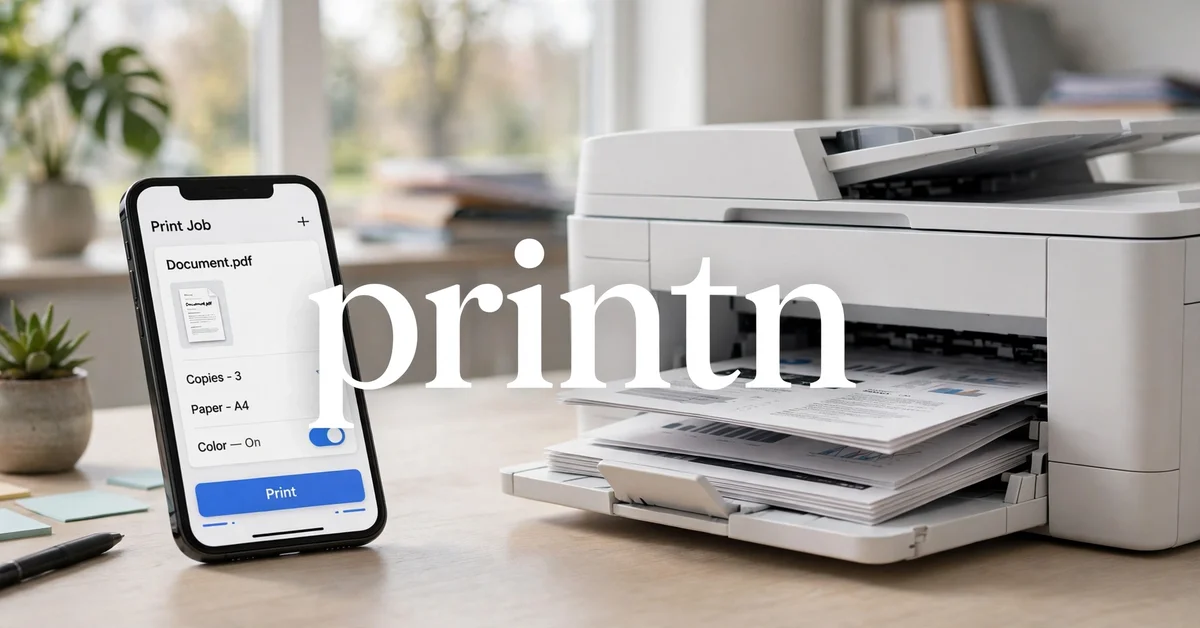
The most common meaning is Printt, spelled with two t’s. It is a UK printing app that lets you print documents from your phone without owning a printer. You upload a PDF, Word file, PowerPoint, or photo, choose black and white or colour, single or double sided, and pay in the app. Then you pick one of three ways to get your prints: collect from more than 300 shops in up to 2 hours, print yourself at one of more than 200 Printt printers by scanning a QR code, or get the documents delivered to any UK address.
The numbers on its store pages are large: more than 25 million pages printed by more than 170,000 people, and more than 675,000 customers. Students use it for assignments, job seekers for CVs, travellers for boarding passes. It is GDPR compliant, and only vetted professionals handle printing at its factories. If you typed “printn” looking for a way to print something from your phone, Printt is almost certainly what you meant.
printn in programming
The second meaning lives in code. In the GNU fussy manual, the printn statement is exactly the same as the print statement, except it emits a newline character at the end. In the FLINT library for number theory, functions such as acb_printn, qqbar_printn, and ca_mat_printn print numbers and matrices to standard output. A programmer searching for “printn” is usually looking for one of these: a small command that prints a value and moves to a new line. It has nothing to do with printers, paper, or printing services.
PRINT, the particle technology
The third meaning comes from science. PRINT stands for Particle Replication in Nonwetting Templates, a molding technology that makes precisely defined micro and nanoparticles. It adapts lithographic techniques from the microelectronics industry and roll-to-roll processes from the photographic film industry, and it gives researchers control over particle size, shape, composition, cargo, and surface properties. It is a GMP-compliant platform, which means it can be used for particle fabrication at large scale. If you found the word in a research paper, this is the PRINT you are looking for.
Printn, Printt, Princh, and the Rest
The confusion does not stop at three meanings. Several printing services have names that look almost the same, and they do different things.
| Name | What it is | Where it works |
|---|---|---|
| Printn | A parked domain, no service | Nowhere |
| Printt | Phone printing app, collect or deliver | UK, 300+ shops |
| Princh | Find a nearby printer and pay by card | Libraries and print shops, several countries |
| PrintIn | Cloud queue for print shops | India, pay at the counter |
| Printed Mint | Print on demand for online stores | US, Phoenix, Arizona |
Printt and Princh both solve the same problem, printing without a printer, but in opposite ways. Printt prints your file itself and brings it to you or a shop. Princh finds a printer near you and lets you print on it. PrintIn is different again: it is a queue system for print shops, not a service for walk-in customers. Printed Mint is for sellers, not for people who need a document printed. Knowing which one you need saves you from downloading the wrong app.
Every Short Name Is Not a Startup
Here is the misconception most pages carry into this topic: if a short name is searched a lot, there must be a startup behind it. It does not work that way. A short name can be a parked domain, a typo, a programming command, or an acronym from a science paper. Search volume is not proof of a company.
The same mistake shows up with other odd names. We saw it with Revealspro, where one page called it a tax service and another called it an SEO tool, while the real site turned out to be a plain general blog. The lesson is the same here: check the domain itself before you trust any description of it. A name that sounds like an app is not proof of an app.
How to Find What You Actually Want
If you want to print a document from your phone, search for Printt with two t’s, or for Princh if you would rather walk to a nearby printer. Both have real apps, real prices, and real reviews.
If you want the programming command, search for it with the language or library attached, such as “printn GNU fussy” or “acb_printn FLINT”. That narrows the results to documentation instead of app listings.
If you want the science, search for “PRINT particle replication” or “PRINT technology nanoparticles”. The research paper and its citations will come up first.
And if you only typed “printn” out of curiosity, now you know the answer: there is no service by that name. The domain is parked, and the word belongs to three other things.
Conclusion
Printn is a name with no single service behind it. Its domain is parked and empty, and the word points in three directions: Printt, the UK printing app, a code statement, and PRINT, a particle molding technology. The guides that describe a printing service by this name are describing something that does not exist. Check the domain, spell the name carefully, and pick the meaning that matches what you actually want. Do that, and the confusion disappears.
FAQ
What is printn?
Printn is not one service. The domain printn.com is parked and empty. Most searchers mean Printt, a UK printing app, a printn statement in programming, or PRINT, a particle molding technology.
Is printn.com a real printing service?
No. The domain is parked, with no products, prices, or ordering. A directory listing calls it a printing service, but that description does not match the site itself.
What is the difference between printn and Printt?
Printn is a parked domain with no service. Printt, spelled with two t’s, is a real UK printing app with more than 300 collection shops, self-service printers, and delivery.
What does printn mean in programming?
In the GNU fussy manual, printn is the same as the print statement, except it adds a newline at the end. In the FLINT library, functions like acb_printn print numbers and matrices to standard output.
What is PRINT technology?
PRINT stands for Particle Replication in Nonwetting Templates, a molding technology that makes precisely defined micro and nanoparticles for research and large-scale fabrication. It is not a printing service.
Keep reading: our DigitalConnectMag guide does the same check on another site whose descriptions disagree with each other.

Type miflow into Google and the first results will tell you about machine learning. They are wrong, or at least they are answering a different question. The name you typed, spelled with a small m and one word, belongs to a business software product for agencies. The machine learning platform is MLflow, with capital M and L, and it is a different product from a different company. That one capital letter is the whole confusion, and it sends a lot of people to the wrong page. This guide gives you the right one: what miflow actually is, what it does, what it costs, and how to tell it apart from the lookalikes.
At a Glance: Miflow is project software for agencies, at miflow.io. It turns services into trackable products and shows project health and margins in real time. It starts at 6.99 euros per user per month. It is not MLflow, the open-source machine learning platform.
What Miflow Actually Is
Miflow is software for agencies, built by someone who ran one. The founder tells the story on Product Hunt: he began as a creative director in an agency, felt the chaos in creative work and the struggle to track project profitability, and watched that turn into stagnant salaries and stalled team growth. He tried around 25 tools, and none of them gave him the picture he wanted. So he built miflow, an ERP software designed specifically for agencies, to give a clear picture of project health and make the workflow smoother.
The idea is simple. An agency sells services, and services are hard to track: hours slip, costs hide, and nobody knows whether a project actually made money until it is over. Miflow turns each service into a defined, traceable product, centralizes all the project data in one place, and gives the agency a real-time photo of its projects. Budgets get accurate, and direct and indirect margins stay visible instead of discovered too late.
The product has moved since that first version. Its current homepage, at miflow.io, presents it in Spanish as an AI connector that unifies ERP, human resources, and operations data into one business-intelligence view, so a company can know its profitability in real time. The agency focus is still there, but the pitch has widened: connect budgets and invoices, watch margins, follow project progress, and make decisions from real data instead of guesses.
What It Does
Three things matter most, and they are the same in the old listings and the current site.
Budgets and margins
Miflow helps agencies create accurate budgets and protect margins. It tracks direct costs, such as the hours a team spends, and indirect costs, such as overheads, so the margin on a project is visible while the work is still happening. That is the feature the founder built it for, and it is still the headline.
A real-time photo of your projects
The product’s own line is that it centralizes all the data you need to give you a real-time photo of your projects. Administrators can monitor project health as it changes, and filter the data by product, client, team, or time period, from a week to a year. Old data from weeks ago is the enemy here: the point is to see the project as it is now, not as it was last month.
Tasks, time, and teamwork
Underneath the margins, it is also ordinary project software: task management, Kanban boards, workflow oversight, time and expense tracking, customizable reports, document storage, and role-based permissions. It runs on the web, Android, and iPhone, and it offers email support, a help desk, FAQs and a forum, chat, and training in person, live online, and by webinar. It is designed for marketing services, creative agencies, IT, design, consulting, architecture, law, construction, and accounting.
What It Costs
Pricing is public on the software directories, last updated October 2026. All prices are per user per month, in euros, on a subscription, with a free plan and a free trial.
| Plan | Price per user per month | What it is for |
|---|---|---|
| Micro | 6.99 euros | The smallest plan, for trying it out |
| Basic | 9.99 euros | Small teams getting organized |
| Professional | 14.99 euros | Agencies that need the full picture |
The free trial is genuinely usable but limited: you can set up services, users, clients, projects, hours, invoices, and quotes, but only up to 3 users, 3 projects, and 3 services. That is enough to test whether the margin tracking works for your agency before paying. Prices change, so confirm them on the official site before you buy.
Miflow, MLflow, and the Rest
The name is shared by several different products, and the differences matter more than the spelling.
| Name | What it is | Who it is for |
|---|---|---|
| miflow | Agency software, budgets and margins | Agencies and small businesses |
| MLflow | Open-source machine learning lifecycle platform | Developers and data scientists |
| MFlow | Haskell web framework | Haskell programmers |
| M-Flow | AI delivery intelligence for engineering teams | Engineering teams using Jira or Trello |
| Miflow Login | Microfinance collection portal by L&T Finance | Loan collection agents in India |
MLflow is the big one. It was created by Databricks and later donated to the Linux Foundation, and it tracks machine learning experiments, packages models, and manages deployment. It is free and open source, and it runs anywhere. If you are a data scientist, that is your tool. If you run an agency, it is not.
The L&T Finance portal is a different case again. It is a microfinance collection repository, used by loan collection agents and bank employees to track loans and payments. It shares the name and nothing else. Do not mix it up with the agency software, and do not enter loan or payment details on any page you reached by searching the name alone.

One Capital Letter Changes Everything
Here is the misconception most pages carry into this topic: a small spelling difference does not matter. With this name, it changes everything. “miflow” in lowercase is agency software. “MLflow” with capital M and L is a machine learning platform. “MFlow” with a capital F is a Haskell web framework. Search engines do not always respect the capital letters, so the results mix them together, and a guide that does not check the case will describe the wrong product with total confidence.
The same mistake shows up with other odd names. We saw it with DigitalConnectMag, where the homepage gave two different answers about what the site was, and only the site itself could settle it. The lesson is the same here: check the exact spelling, then check the site itself. A name that looks the same is not proof of the same product.
Who Should Use It
Miflow fits agencies and small businesses that sell services and need to know whether those services make money. If your problem is that hours slip, costs hide, and margins appear only after a project ends, this is the kind of tool built for that problem. Freelancers and small teams can start on the cheapest plan and test it with the free trial’s 3 users and 3 projects.
It does not fit everyone. If you are a developer looking for experiment tracking, use MLflow. If you are an engineering team that lives in Jira, look at M-Flow. And if you only need a simple to-do board, a cheaper general tool will do, because miflow’s real value is the margin and profitability view, not the task list. Buy it for the numbers, not for the board.
Conclusion
Miflow is agency software, not a machine learning tool. It turns services into trackable products, centralizes project data, and shows budgets, health, and margins in real time, starting at 6.99 euros per user per month. Its founder built it after trying 25 tools that could not show him whether his agency’s projects made money. The name is shared with MLflow, MFlow, and a microfinance portal, so check the spelling and the site before you trust any result. Do that, and the confusion disappears.
Frequently Asked Questions
What is miflow?
Miflow is project software for agencies, at miflow.io. It turns services into trackable products, centralizes project data, and shows project health and margins in real time.
Is miflow the same as MLflow?
No. Miflow is agency software for budgets and margins. MLflow is an open-source platform for managing the machine learning lifecycle, created by Databricks and donated to the Linux Foundation.
How much does miflow cost?
Pricing starts at 6.99 euros per user per month, with Basic at 9.99 and Professional at 14.99. There is a free plan and a free trial, limited to 3 users, 3 projects, and 3 services.
What is miflow used for?
Agencies use it to budget accurately, protect margins, track project progress, and see the health of their projects in real time, instead of finding out whether a project made money after it ends.
Is miflow free?
There is a free plan and a free trial. The trial lets you set up services, users, clients, projects, hours, invoices, and quotes, up to 3 of each, before you pay.
Keep reading: our Charfen guide does the same check on another site whose homepage gives two different answers.

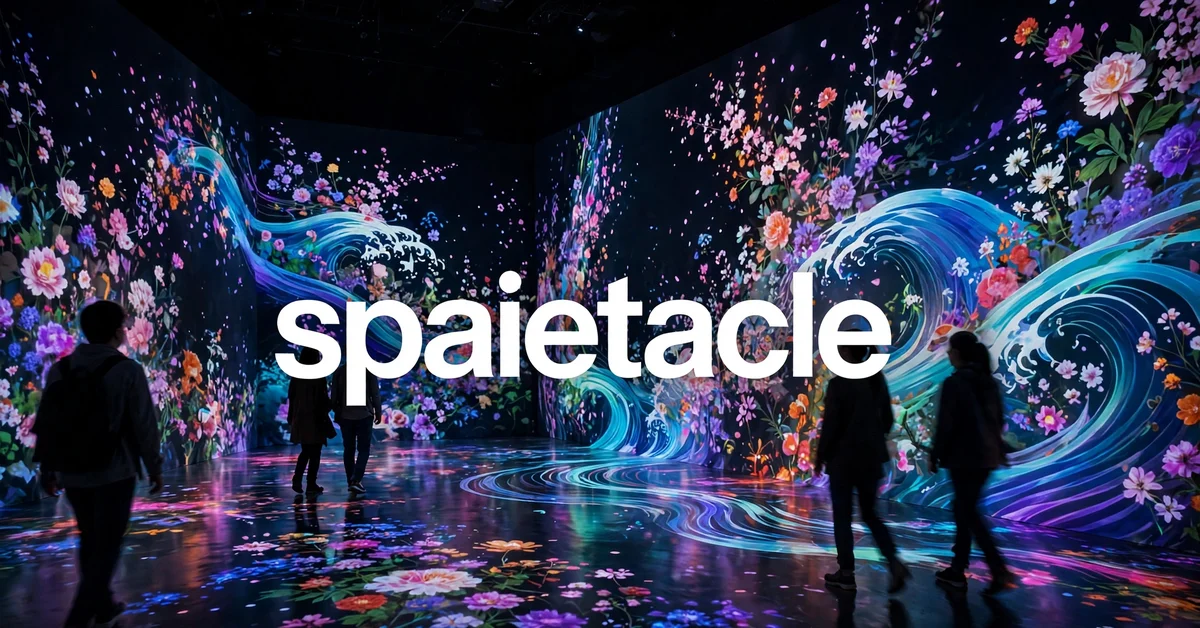
Walk into a dark hall in Tokyo and the floor under your feet fills with light. Flowers bloom where you step, then scatter and fade. The walls shift around you. There is no stage, no seats, and no curtain. You are inside the artwork, and the artwork is responding to you. That is teamLab Borderless, and it is the example every writer gives of a spaietacle.
The word is new, and you may have seen it in a design blog or a conversation about entertainment without any explanation. Here is what it means, how to tell one from a nicely decorated room, and where you can walk into one yourself.
At a glance: Spaietacle means space plus spectacle. It is a coined word, not a dictionary word. The best example is teamLab Borderless in Tokyo. It is not virtual reality, and it is not a product you can buy.
What Spaietacle Means
At its simplest, a spaietacle is an immersive experience in which the setting does the work of a stage. Lighting, sound, texture, scent, and movement are layered with intent, and the route tells a story. Visitors choose a path, and the space answers them. That exchange is what separates the idea from a decorated room.
The blend is the whole idea. The first half gives the setting, a room or a hall. The second half gives the drama, something worth watching. The goal is not to show you something. The goal is to put you inside it, so the place itself carries the performance and you complete it by moving through it.
The two halves of the word
“Space” comes from Latin spatium. “Spectacle” comes from Latin spectaculum, a public show, from spectare, to watch. Merriam-Webster defines spectacle as something exhibited to view as unusual, notable, or entertaining, first used in the 14th century. Put the two halves together and the meaning is plain: a space arranged to be watched, walked through, and felt, rather than a stage you sit in front of.
A new word, not a dictionary word
Spaietacle has no entry in any standard dictionary, and no source names who coined it or when it first appeared. The earliest dated page found is from August 2025. That makes it a working term, not an established one. Different writers use it to mean slightly different things, but the dominant meaning is always the same: immersive experience design, where space does the work a stage used to do. It is not a product, a platform, a brand, or a piece of software. You cannot buy a spaietacle. It is a way of thinking about how an experience is built. The fullest guide I found, from Ravenshook, published 17 November 2026, lists five elements that keep appearing across the best guides: spatial storytelling, sensory design, participation, spectacle and surprise, and emotional coherence.
Three Signs You Are Standing in One
No top result gives you this test in one place, so here it is. If you are wondering whether a place counts as a spaietacle, check three things.
First, did you walk into the setting instead of sitting down to watch it? In a spaietacle there are no seats between you and the experience. You are inside it from the first step.
Second, does the space answer you? A decorated room stays the same whatever you do. In a spaietacle, your movement changes something: a floor lights up, a wall shifts, a sound follows you, a door opens onto a new scene.
Third, is there a route with a story in it? The order in which things are revealed matters. Something is hidden at first, then shown, then paid off at the end. If all three signs are there, you are in one. If only the decoration is there, you are in a nice room, not a spaietacle.
Spaietacle, Immersive Theatre, and Virtual Reality
The word is often confused with two neighbours. One question separates them: where is the audience, and what does the space do?
| Form | Where the audience is | What the space does |
|---|---|---|
| Spaietacle | Inside it, moving through | The space is the performance |
| Spectacle | Watching from a distance | The stage or screen holds the show |
| Immersive theatre | Inside it, among performers | The set supports an acted story |
| Virtual reality | Inside a headset | A digital world replaces the room |
Immersive theatre can be one part of a larger experience of this kind, but the idea is broader: it covers exhibitions, retail, and public installations too, with no actors at all. Virtual reality is a tool, not a synonym. The concept works without any headset, using light, sound, architecture, and live performers instead.
Where You Will Actually Meet One
Writers keep returning to the same examples, and they are worth knowing because they show how wide the idea reaches.
teamLab Borderless in Tokyo is the clearest large-scale example: a digital art museum where installations shift around the visitors, and artworks move from room to room instead of hanging still. Cirque du Soleil is the stage example named most often: acrobatics, theatre, and music built into one unified world, where the room itself becomes part of the act.
The idea also turns up in smaller places. The Museum of Ice Cream in Los Angeles is the retail example: visitors walk through themed rooms instead of browsing shelves. A boutique hotel corridor from one practical guide used seasonal scents and motion-triggered narration, and guests lingered longer and shared more photos. Festivals use it to turn a square into a shared event. Apple product launches are the business example: staged anticipation, a darkened hall, a single reveal. Projection mapping does the same to buildings, with light on a facade making it seem to move and tell a story.
You do not need to fly to Tokyo to meet one. Immersive art exhibitions tour major cities, festivals project onto buildings, and interactive museum rooms use the same ideas at a smaller scale. The test is always the same: if you walked into the setting instead of watching from seats, and the place itself carried the experience, you were in a spaietacle.
It Does Not Need a Big Budget or a Headset
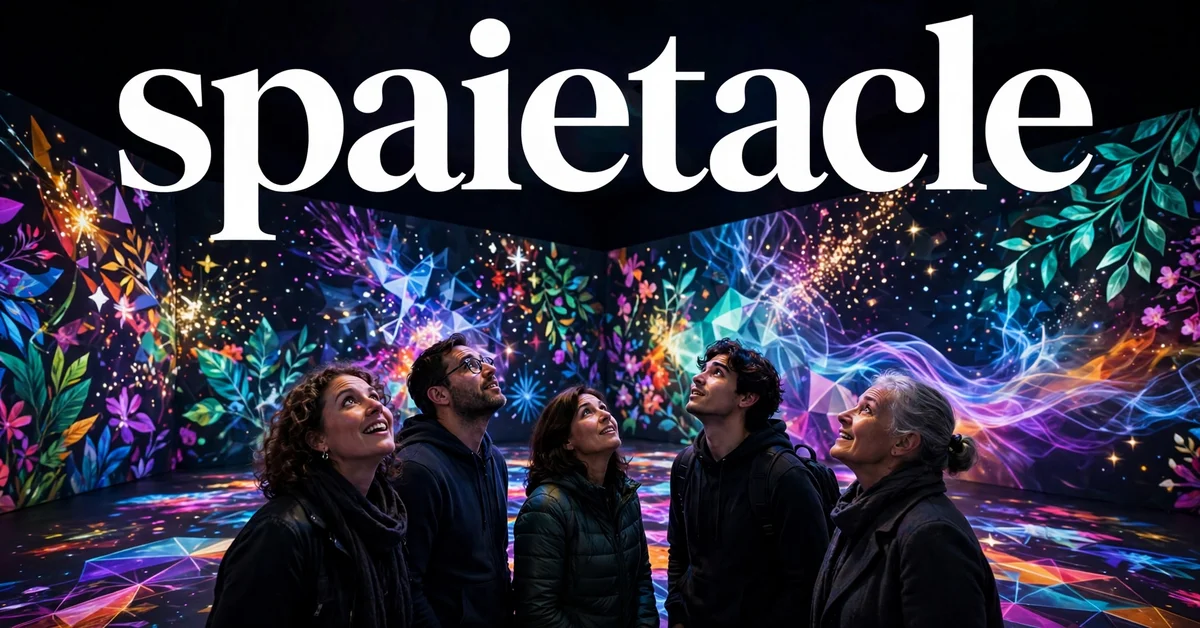
Here is the misconception most people carry into this topic: a spaietacle must be expensive, high-tech, and built by a big studio. That is not true, and the guides agree on it. A spaietacle is not a matter of budget. A small room with careful light can work, and the design is the point, not the money spent on it.
The boutique hotel corridor proves it. Seasonal scents at the entrance, motion-triggered narration in each alcove, and a changing light horizon at the end. No headsets, no huge screens, no famous artists. Guests still lingered longer and shared more photos, which is the sign that the space became the story.
The same goes for technology. Virtual reality can help, but the idea does not need it. Light, sound, texture, and a planned route can do the work on their own. What matters is the sequence: start with the story, design the route before the decoration, layer the senses only where they support the story, give visitors something to do, and test it with real people. A door to open, a choice to make, a floor that responds. Participation turns a display into an experience, and none of that needs a big budget.
The other half of the misconception is the idea that a spaietacle is only for art. Museums use it to make exhibitions feel like journeys. Retailers use it to make a shop worth visiting. Hotels use it to give guests something to remember. The place is designed first, and the message rides on the experience of being there.
Could a Small Space Become One?
Yes, and the practical guides are clear about how. Start small and test quickly. Design the emotional arc first, then add one dominant sensory anchor, such as sound, and support it. Use low-tech mockups: cardboard walls, phone-driven audio, and a few timed lights. Testing emotional response is cheap and revealing.
The pitfalls are the same at every size. Do not overload the senses without a narrative, or the result is beautiful chaos that confuses. Do not rely on flashy tech without testing how people actually walk through the space. Do not forget accessibility: sensory richness must include alternative cues, captions, quiet moments, and clear wayfinding, so different needs are respected. And do not treat it as a one-off marketing stunt instead of a planned interaction. Measure attention and recall, not just footfall.
A storefront or a park bench can become one with an intentional sequence, sensory anchors, and a reason for people to stay. The magic is in the design choices, not the budget.
Spaietacle is a young word for an old human impulse: making a place feel like an event. It means space plus spectacle, an experience where the setting itself becomes the show and visitors walk inside the story instead of watching it from seats. The word has no dictionary entry and no known coiner, and it may or may not survive as a term. The experiences it describes already have, and they are getting easier to find.
What does spaietacle mean?
Spaietacle is a coined blend of “space” and “spectacle”: an experience in which the environment itself becomes the show, and visitors walk into the setting and take part in the story. The space does the work a stage used to do, and visitors take part by moving through it.
Is spaietacle a real word?
Not in the dictionary sense. It is a modern coined term, not listed in standard dictionaries, but it is in active use. The earliest dated page found is from August 2025.
How is a spaietacle different from immersive theatre?
Immersive theatre is one form of it: actors perform a story around the audience. The wider idea also covers exhibitions, shops, and hotels, with no actors at all.
What are examples of a spaietacle?
teamLab Borderless in Tokyo, Cirque du Soleil, Apple product launches, the Museum of Ice Cream in Los Angeles, and a boutique hotel corridor with scents and motion-triggered narration.
Is spaietacle the same as virtual reality?
No. Virtual reality is one tool that can help, but the idea does not need it. Light, sound, architecture, and live performers can create one too, and a headset is never required.
Keep reading: our Revealspro guide does the same check on another odd name, and finds the same pattern.

Dreammeaniing.com is an English-language WordPress site that publishes dream interpretations next to a good deal of unrelated writing, and nothing on it ties it to the United States. The usual questions about dreammeaniing.com USA are whether it’s an American site, whether it’s legitimate, and whether its readings can be trusted. The site’s own pages answer the first with silence, the second with a standard disclaimer, and the third with an admission that the meanings are for entertainment. That last point matters most, because the research behind dream symbols is thinner than the confident tone of most dream pages online suggests.
The Bottom Line
Dreammeaniing.com is a general WordPress blog with a dream interpretation section and an AI chat box. Its About, Disclaimer, and Privacy pages name no company, address, or country, so nothing supports calling it an American site. Treat its readings as entertainment and check any legal or health advice elsewhere.
What dreammeaniing.com USA readers actually get
The dream pages
The homepage promises plain-language dream interpretations, symbolism breakdowns, and spiritual meanings, and the About page describes the method as symbolism, psychology, and common patterns people report. Browse the Dream Meanings category and you’ll find single-topic pages on ex-partners, an octopus, a white owl, hair, and a dream of receiving paper money read through an Islamic lens. A snake-bite page is framed through Hindu astrology, so the site mixes psychological, religious, and astrological frames without telling you which one a given page rests on.
A pop-up labeled Dream Interpretation also invites you to describe a dream and get an AI response. The privacy policy covers comment and contact-form details, Google Analytics, and Google AdSense, and it doesn’t mention the chat feature. Until it does, keep names, health details, and other identifying information out of the box.
The pages that aren’t about dreams
Dream content is now a minority of what gets published. Counting the titles listed on the homepage as of October 23, 2026, three of the ten newest posts are about dreams (arrest dreams, running and straining, hair), while the other seven cover quality processes, an AI video generator, pricing, emergency plans, Amazon repricing, and proprietary trading firms. The Dream Meanings category is no cleaner, since four of the ten posts on its first page, all dated August 2026, are an Instagram story viewer roundup, a pellet dryer explainer, a casino-style gaming review, and a boom lift tracking guide. Those counts will shift as new posts go up.
That mix matters to a US reader in a practical way. The category list runs to 23 entries, including Law, Finance, Health, Crypto, CBD, and Vape, so posts on regulated subjects sit beside dream symbolism under one brand and a generic byline. Rules on online gaming, vaping products, and cannabis-derived items differ by state and by country, and a page that never says where it applies can’t tell you whether it applies to you.
Where the site places itself, and where it stays silent
No page states a company name, street address, or country. The Disclaimer and Privacy Policy refer only to DreamMeaniing and its owners or contributors, and the homepage metadata carries an en_US language tag, which signals American English rather than a US operator. That same metadata dates the homepage to November 24, 2025, so this is a young site.
Where the site does show a location, it isn’t the United States. The arrest-dream article presents its rights checklist as Canadian law, mentions a Feeney warrant, and credits an Edmonton criminal defence firm, while its own disclaimer sends readers to a defence lawyer in their province. A reader in the US who followed that checklist literally would be leaning on another country’s rules, so for anything legal, American procedure and an American lawyer are the right references.
Spelling deserves a glance too. The brand is written with a doubled i, and a recent comment on the site carries a link to dreameaninng.com, a different spelling with a doubled n. Nothing on the pages connects the two, so confirm the exact domain in your address bar before you enter anything or follow advice attributed to either.
Where the “usa” part goes wrong
The assumption behind adding a country to a site name is that there’s a regional edition, a US-based operator, or US-specific rules to find. That habit comes from retail brands with separate country sites, where the extra word really does filter results. For this site it filters nothing, because the pages show one English-language site, nothing pointing to regional editions, and no US-specific content, while the one article that does name a jurisdiction names a Canadian one.
A second slip is treating the odd spelling as a sign of an official variant or a copycat of a better-known dream site. The evidence supports neither idea, since meaniing appears consistently across the title tags, policy pages, and footer, which is how this brand is simply spelled.
What dream symbol readings can and can’t tell you
Dream dictionaries tend to pair one symbol with one meaning, and Wikipedia’s entry on dream dictionaries notes that the psychology community generally doesn’t consider that approach scientifically viable. Carl Jung cautioned against assigning meaning to a symbol without knowing the dreamer’s personal situation. Ann Faraday observed that most dreams seem to reflect what occupied the dreamer’s mind in the previous day or two.
Belief in dream meaning runs high in the US. A 2009 study by Carey Morewedge and Michael Norton, summarized on Wikipedia’s dream interpretation page, found that 56% of Americans believed their dreams gave meaningful insight into their unconscious beliefs and desires, against 74% of Indians and 65% of South Koreans. Participants also rated dreams as more meaningful than similar waking thoughts, and they judged a dream more meaningful when it matched what they already believed or wanted.
That pattern points to a simple rule: a reading works as a question, not a verdict. Before accepting any page’s interpretation, run it past these three prompts.
- What happened or worried you in the last two days?
- What did you feel inside the dream itself?
- Does the reading name something you can check or act on, like a conversation you’ve been putting off?
A reading that predicts events, money, or what other people secretly think gives you nothing to test, so skip it. The site’s own disclaimer calls the content educational and entertaining and says readers shouldn’t rely on it alone for important decisions. If nightmares keep disrupting your sleep, a doctor or licensed therapist is a better route than any symbol list.
A short check before you rely on any page there
These five habits take a couple of minutes and catch most problems.
- Match the page to its category. A post filed under Dream Meanings can be a product review, as the August posts show.
- Check the byline and date. Most recent homepage posts carry only the name Admin, so credibility has to come from sources named inside the text.
- Match the jurisdiction. For law, taxes, money, or health, go to an official US source such as your state regulator, not a page that never says where it applies.
- Read promotional posts as promotion. A page that names a company and its products and lists no disclosure shouldn’t be assumed independent.
- Keep the chat box impersonal, since the privacy policy says nothing about how those entries are handled.
Beyond these five, there’s a two-minute check you can run on any unfamiliar site that starts with reading the menu and counting the archive, and it works on odd domain names of every kind.
Conclusion
Dreammeaniing.com USA turns out to be an English-language blog with a dream section, no stated country, a mix of unrelated posts, and readings that work best as prompts for your own reflection. Pick the dream page that matches what you saw, jot down what you felt and what happened the day before, and decide whether the reading fits before you accept it. If a post touches law, money, or health, check it against an official source from your own country first.
FAQ
Do I need an account or a payment to read the pages?
The privacy policy says no personal information is collected just to access content, and no pricing or login page shows up in the menu. The site is supported by Google AdSense ads, according to its disclaimer.
Can I ask the site for a personal reading of my dream?
The Contact page invites readers to ask a question, request a dream interpretation, or report a problem on the site. It doesn’t say who answers or how long that takes, so treat any reply as general commentary.
Why does the same dream keep coming back?
Repeating dreams are commonly linked to a stressor or worry that hasn’t been resolved. A short journal with the date, the main image, and your mood on waking makes the pattern easier to spot over a few weeks.
Is dream interpretation a modern idea?
Not at all. Wikipedia traces written dream interpretation in Mesopotamia back to at least 3100 BC, and later authors include Artemidorus in the 2nd century AD and Ibn Sirin (654 to 728), whose works still shape how dreams are read in many communities.
Is the site meant for children?
The privacy policy states it isn’t directed at children under 13 and that it doesn’t knowingly collect their information. Younger readers who get scared by a dream are better helped by a parent or caregiver than by a symbol list.
-
 TECH2 months ago
Revealspro.com Is a General Blog, Not a Tax or SEO Tool
-
 TECH1 month ago
What Demonscans Is and Where to Read Manhwa Legally
-

 BUSINESS1 month ago
What Growth Navigate Funding Means, With Worked Numbers
-

 TECH1 month ago
Dreammeaniing.com USA Site Facts for American Readers
-

 TECH1 month ago
What charfen.co.uk Publishes and Who Writes It
-

 TECH1 month ago
What digitalconnectmag.com Publishes and Who Writes It
-
 TECH2 days ago
Spaietacle: When the Room Itself Becomes the Show
-

 General2 days ago
Jalbiteblog: The Food Blog Behind the Name